
| Specification | Detail |
| Category | Amylin Analogues & Metabolic Research |
| Product Name | Cagrilintide (Long-acting Amylin Analogue) |
| Quantity | 10mg (Total Active API) |
| Formulation | Sterile Lyophilised Solution in Bacteriostatic Water |
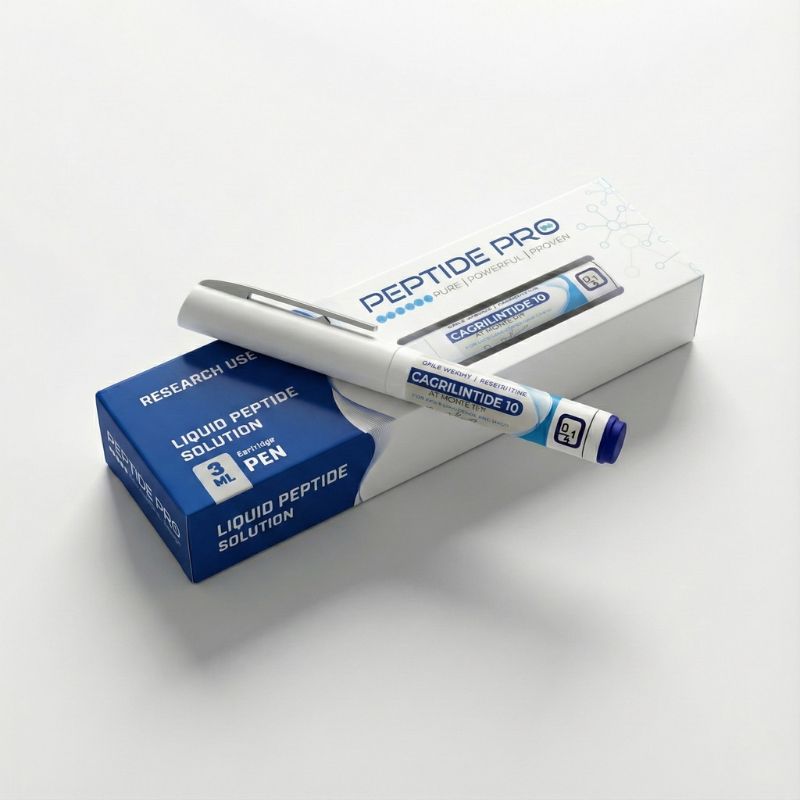
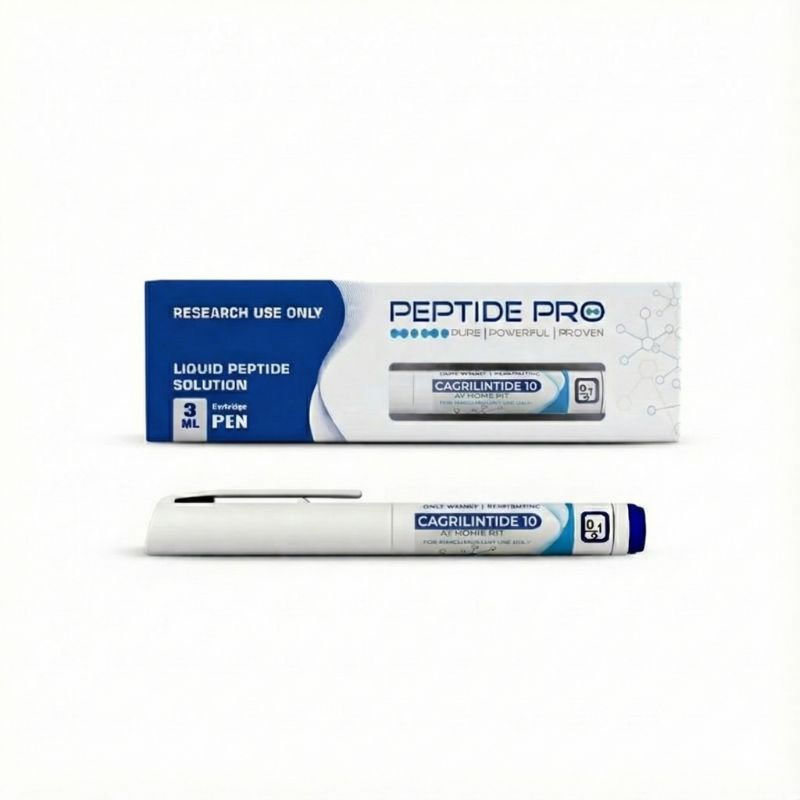
| Delivery Method | 3ml Precision Reconstituted Pen |
| CAS Number | 1415456-99-3 |
| Molecular Formula | $C_{165}H_{264}N_{44}O_{56}S_{2}$ |
| Molecular Weight | $\approx 4493.1 \text{ g/mol}$ |
| Purity | >99% (HPLC Analysis) |
£209.00 Original price was: £209.00.£199.00Current price is: £199.00.
Cagrilintide 10mg peptide pen features a long-acting amylin analogue, representing the next frontier in non-incretin metabolic research. Unlike GLP-1 receptor agonists, Cagrilintide mimics the endogenous hormone amylin, which is co-secreted with insulin by pancreatic beta-cells. This compound is critical for researchers investigating the neuroendocrine regulation of feeding behaviour, specifically through the activation of amylin receptors (AMY) and calcitonin gene-related peptide (CGRP) receptors in the hindbrain. Initially identified during research into adjunctive therapies for weight management, Cagrilintide is now a primary subject of study for its ability to induce satiety and modulate gastric emptying independently of the incretin system. This 3ml pen format offers a high-concentration, sterile solution optimised for precise titration in combinatorial studies, particularly those examining synergistic effects with GLP-1 analogues.
Primary Biological Pathway: Amylin Receptor Activation
Cagrilintide functions as a potent, non-selective agonist for amylin receptors (AMY1, AMY2, AMY3) and the calcitonin gene-related peptide receptor. The primary research interest lies in its interaction with the area postrema and the nucleus of the solitary tract in the brainstem. By binding to these receptors, the peptide initiates a signalling cascade that mimics the physiological “satiety signal” normally generated after nutrient ingestion. Unlike short-acting endogenous amylin, Cagrilintide has been acylated to allow for reversible binding to albumin, significantly extending its half-life in test subjects and allowing for steady-state observation of appetite suppression pathways.
Secondary Research Finding: Regulation of Gastric Motility
A critical area of investigation for Cagrilintide is its profound effect on gastric emptying rates. In pre-clinical trials, the administration of the peptide has been shown to slow the transit of gastric contents into the duodenum. This mechanism is essential for blunting post-prandial glucose excursions. Researchers are currently exploring how this delay in gastric emptying correlates with reduced food-seeking behaviour in rodent models, specifically distinguishing between vagal nerve mediation and direct hormonal signalling.
Tertiary Research Finding: Glucagon Suppression and Glucose Homeostasis
Beyond its central effects on satiety, Cagrilintide is observed to modulate glucagon secretion. Research indicates that amylin analogues can suppress the inappropriate secretion of glucagon from pancreatic alpha-cells during periods of hyperglycaemia. Crucially, this suppression appears to be glucose-dependent, meaning it does not interfere with the counter-regulatory response to hypoglycaemia. This “smart” regulation of glucagon makes Cagrilintide a high-value target for research into stabilising glycaemic variability in models of Type 2 Diabetes.
Long-term Genomic and Safety Observations
Current longitudinal studies are evaluating the safety profile of sustained amylin receptor agonism. Of particular interest is the absence of nausea-related pica behaviour in animal models compared to earlier amylin iterations. Furthermore, genomic analysis is being conducted to ensure that long-term exposure does not downregulate receptor sensitivity (tachyphylaxis). Preliminary data suggests that Cagrilintide maintains efficacy over extended periods, making it a stable compound for chronic administration studies.
Purity: Validated at >98+% via High-Performance Liquid Chromatography (HPLC). We provide certificates of analysis to verify the absence of truncated peptides or synthesis impurities.
Appearance: The 3ml pen chamber contains a clear, colourless, and sterile liquid.
The pen delivery system lets you give the peptide in very small amounts, which is important for measuring how it affects small animals.
Storage: The peptide structure is preserved at temperatures between $2^{\circ}C$ and $8^{\circ}C$.
Refrigeration and Shelf Life
The Cagrilintide 10mg Pen is temperature-sensitive. It must be stored in a refrigerator ($2^{\circ}C$ to $8^{\circ}C$) immediately upon arrival. While the sealed pen has a shelf life of up to 18 months, once the seal is compromised for the first experiment, the bacteriostatic environment ensures stability for approximately 28 days. Researchers should plan their protocols to utilise the full 10mg quantity within this window to prevent data drift caused by oxidation.
Shipping Stability
The molecular stability of Cagrilintide allows it to withstand ambient temperatures for up to 28 days.
This resilience is due to the specific pH buffering of the solution, ensuring the product arrives at your laboratory with its bioactivity fully intact.
Freezing Warning
Strictly avoid freezing. Storing the pen below $0^{\circ}C$ will cause the liquid solution to expand and crystallise. This physical change can shear the long-chain peptide structure ($denaturation$), rendering the molecule biologically inert. Additionally, freezing risks fracturing the glass cartridge of the pen.
In high-throughput research environments, consistency is the primary variable of concern. The Cagrilintide 10mg Pen is engineered to eliminate the variances associated with manual reconstitution. By delivering a pre-dissolved, sterile, and concentration-verified solution, we remove the risk of pipette error and contamination.
This format is particularly advantageous for researchers conducting “stacking” studies, where Cagrilintide is investigated alongside other metabolic agents. The pen’s precision ensures the maintenance of exact molar ratios when co-administering with other peptides.
For laboratories investigating combinatorial therapies, we strongly recommend reviewing the following related compounds:
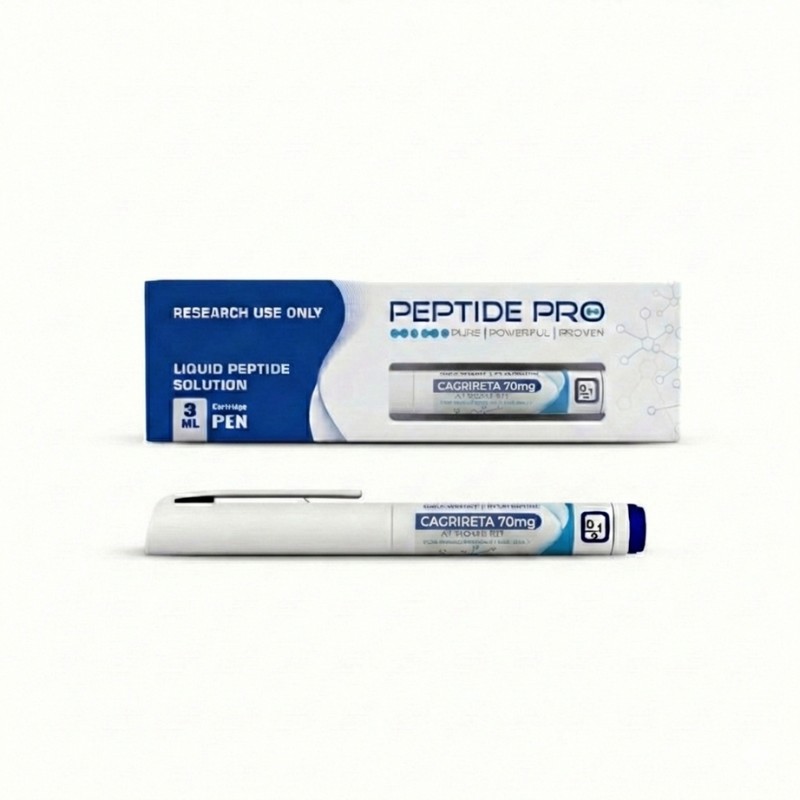
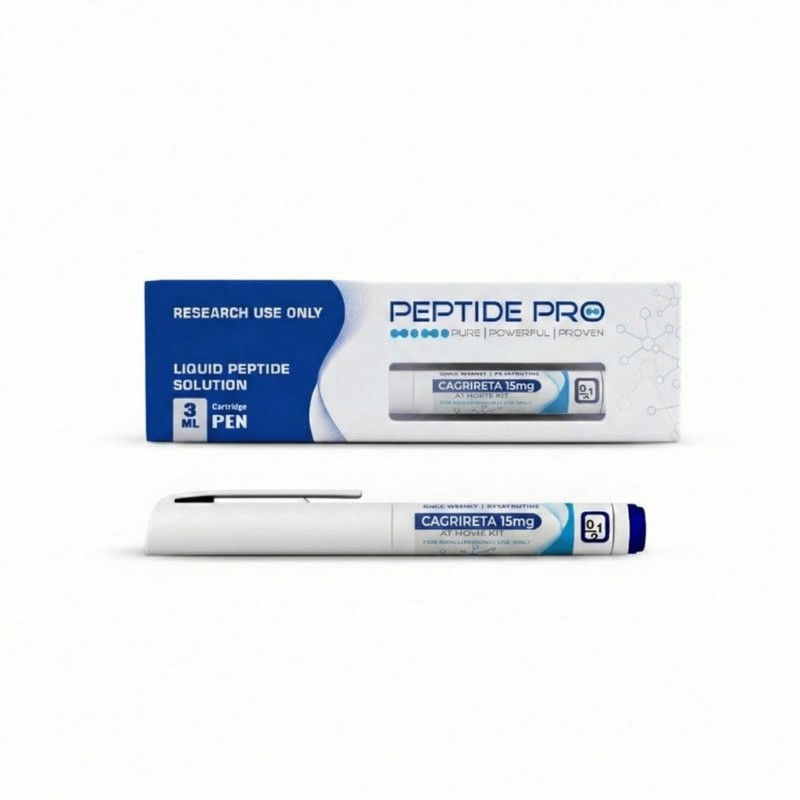
Cagrireta 15mg: (Investigating the Triple Agonist interaction).
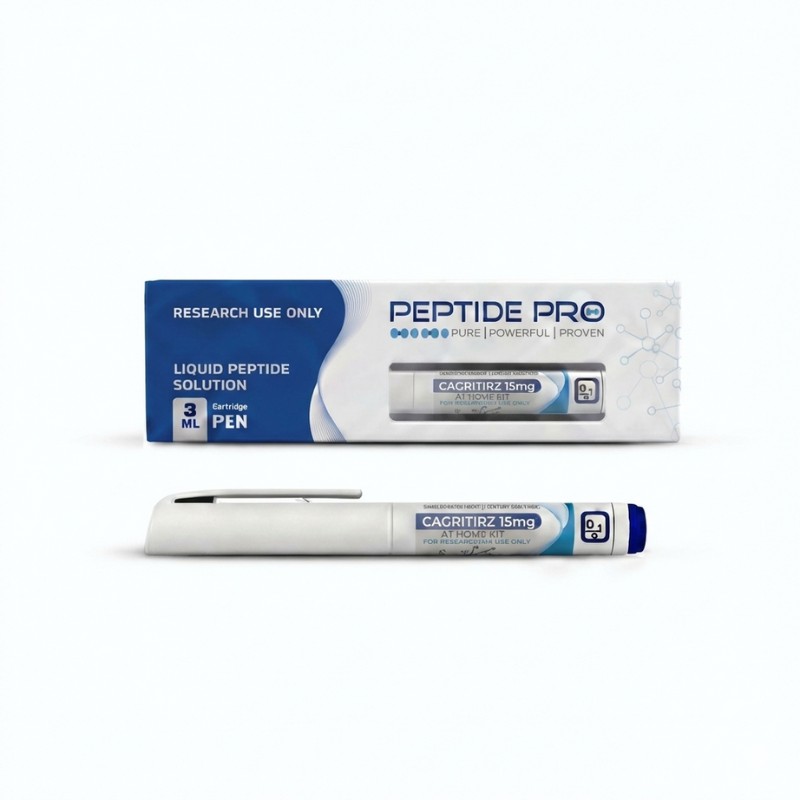
Cagritirz 15mg: (For comparative data on dual-agonist efficacy).
This product is designated for Research Use Only (RUO). It is explicitly not for human use, therapeutic application, or diagnostic procedures. The information presented here is for educational and academic purposes. The sale of this peptide is restricted to qualified researchers and laboratory professionals. Any indication of intended human consumption will result in the immediate cancellation of the order and blacklisting from future purchases, in accordance with UK chemical supply regulations.
Explore our high-purity compounds — including Retatide (Retatrutide 30 mg), Semaglutide, and more.
Fast UK shipping. Lab-tested quality. Strictly for research use only.