
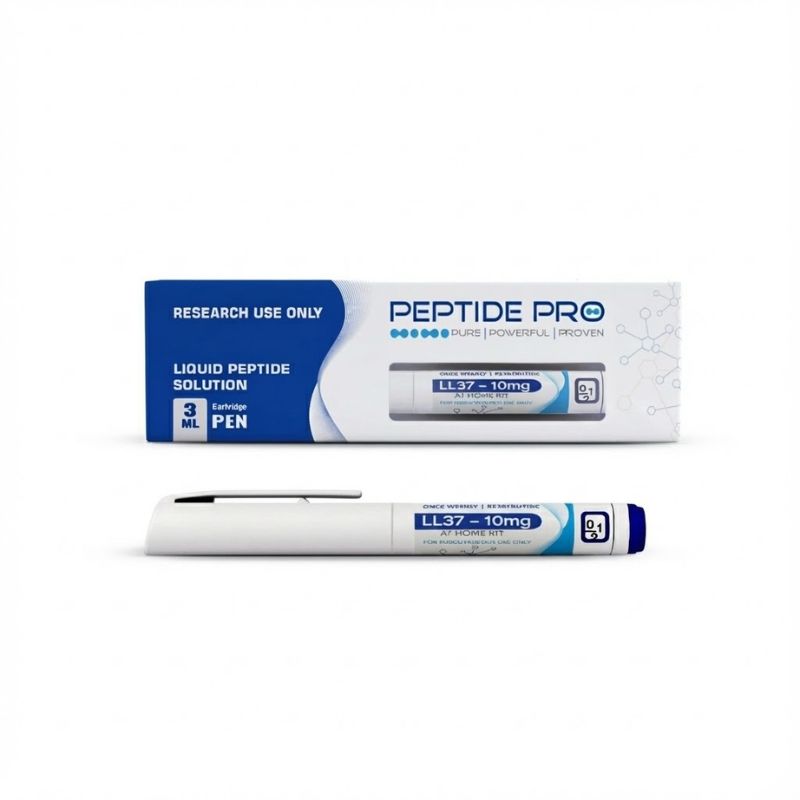
| Specification | Detail |
| Category | Antimicrobial & Immunomodulatory Research |
| Product Name | LL-37 (Cathelicidin Antimicrobial Peptide) |
| Quantity | 10mg (Total Active API) |
| Formulation | Sterile Lyophilised Solution in Bacteriostatic Water |
| Delivery Method | 3ml Precision Reconstituted Pen |
| CAS Number | 154947-66-7 |
| Molecular Formula | $C_{205}H_{340}N_{60}O_{53}$ |
| Molecular Weight | $\approx 4493.3 \text{ g/mol}$ |
| Purity | >98% (HPLC Analysis) |
£139.00
Abstract The LL-37 10mg peptide pen provides a high-concentration solution of the human cathelicidin antimicrobial peptide (hCAP18 derivative). This cationic, amphipathic peptide is a fundamental component of the innate immune response, functioning as both a direct broad-spectrum antibiotic and a potent immune signalling molecule. The 10mg formulation is specifically designed for advanced research protocols requiring high molar loads, such as the eradication of mature, multi-species biofilms or the investigation of wound healing kinetics in chronic ulcer models. By disrupting bacterial membranes via the “carpet” or “toroidal pore” mechanisms, LL-37 offers a critical alternative pathway to traditional antibiotics, making it a primary subject of study in the fight against antimicrobial resistance (AMR).
Primary Biological Pathway: Membrane Permeabilisation LL-37 is unique in its ability to target the fundamental lipid architecture of microbial membranes. Its amphipathic α-helical structure allows it to bind to the negatively charged outer membrane of Gram-negative bacteria (interacting with LPS) and the inner peptidoglycan layer of Gram-positive bacteria. The 10mg concentration is essential for studying “resistant” phenotypes, specifically measuring the concentration required to overwhelm efflux pumps and membrane modifications (like lipid A acylation) that bacteria employ to resist lower doses of AMPs.
Secondary Research Finding: Chemotaxis and Immune Recruitment Beyond direct killing, LL-37 acts as a “danger signal” (alarmin). It binds to the Formyl Peptide Receptor 2 (FPR2) on neutrophils and monocytes, triggering chemotaxis to the site of infection. Research utilising the 10mg pen investigates this receptor-mediated recruitment, distinguishing it from the peptide’s direct lytic activity. Studies focus on the peptide’s ability to enhance the clearance of pathogens by recruiting host immune cells without inducing the excessive inflammation associated with septic shock.
Tertiary Research Finding: Angiogenesis and Re-epithelialization LL-37 is highly expressed in healing wounds but absent in chronic, non-healing ulcers. It promotes angiogenesis (new blood vessel formation) and the migration of keratinocytes. The 10mg formulation is the standard for topical application studies in wound healing models (e.g., diabetic murine models). Researchers use this higher concentration to determine if exogenous supplementation can “jump-start” the proliferation phase of wound repair in tissues where endogenous cathelicidin expression is defective.
Long-term Genomic and Safety Observations Genomic research into LL-37 often explores its regulation by Vitamin D (via the VDRE in the CAMP gene promoter). High-dose studies (using the 10mg equivalent) are critical for establishing the safety profile regarding host cell lysis. While LL-37 kills bacteria, it can be cytotoxic to mammalian cells at high concentrations. Current protocols use this pen to map the therapeutic index, ensuring that the dose used for biofilm destruction does not induce necrosis in the underlying stromal tissue.
Purity: Validated at >98+% via High-Performance Liquid Chromatography (HPLC). We strictly control the synthesis to prevent the formation of truncated analogues, which can have vastly different immunogenic profiles.
Appearance: The 3ml pen contains a clear, colourless, sterile liquid.
Precision: The pen delivery system ensures consistent volumetric dosing, critical for adding precise μM concentrations to culture media or topical wound dressings.
Storage: The product must be stored at 2∘C to 8∘C.
Refrigeration and Shelf Life The LL-37 10mg Pen is a cationic peptide that is sensitive to enzymatic degradation and surface adsorption. It must be refrigerated (2∘C to 8∘C). The shelf life is 12 months in the sealed state. Once the pen is accessed, the bacteriostatic environment preserves the solution for 28 days. Researchers should note that LL-37 can form oligomers in solution; maintaining the correct temperature and pH (buffered in the pen) is vital to keep the peptide in its active monomeric or physiological oligomeric state.
Shipping Stability We utilise medical-grade thermal packaging. The peptide is stable for up to 72 hours at ambient UK temperatures. However, to minimise structural unfolding, we recommend selecting the fastest available shipping option.
Freezing Warning Do not freeze. Freezing can cause the peptide to aggregate irreversibly. Aggregated LL-37 loses its ability to form the specific toroidal pores required for bacterial lysis and may fail to bind to the FPR2 receptor. A frozen pen should be discarded.
The LL-37 10mg Pen is the definitive tool for Biofilm and Resistance Research. Dealing with lyophilised AMPs can be challenging due to their hygroscopic nature and tendency to stick to plastics.
Our pre-reconstituted pen solves these handling issues. It provides a high-concentration (10mg) source that allows for aggressive dosing strategies against mature biofilms (which often require 10-100x the MIC of planktonic bacteria). This format ensures that your research into recalcitrant infections is based on accurate, verified dosing.
For researchers investigating comparative wound healing or immune pathways, we recommend examining:
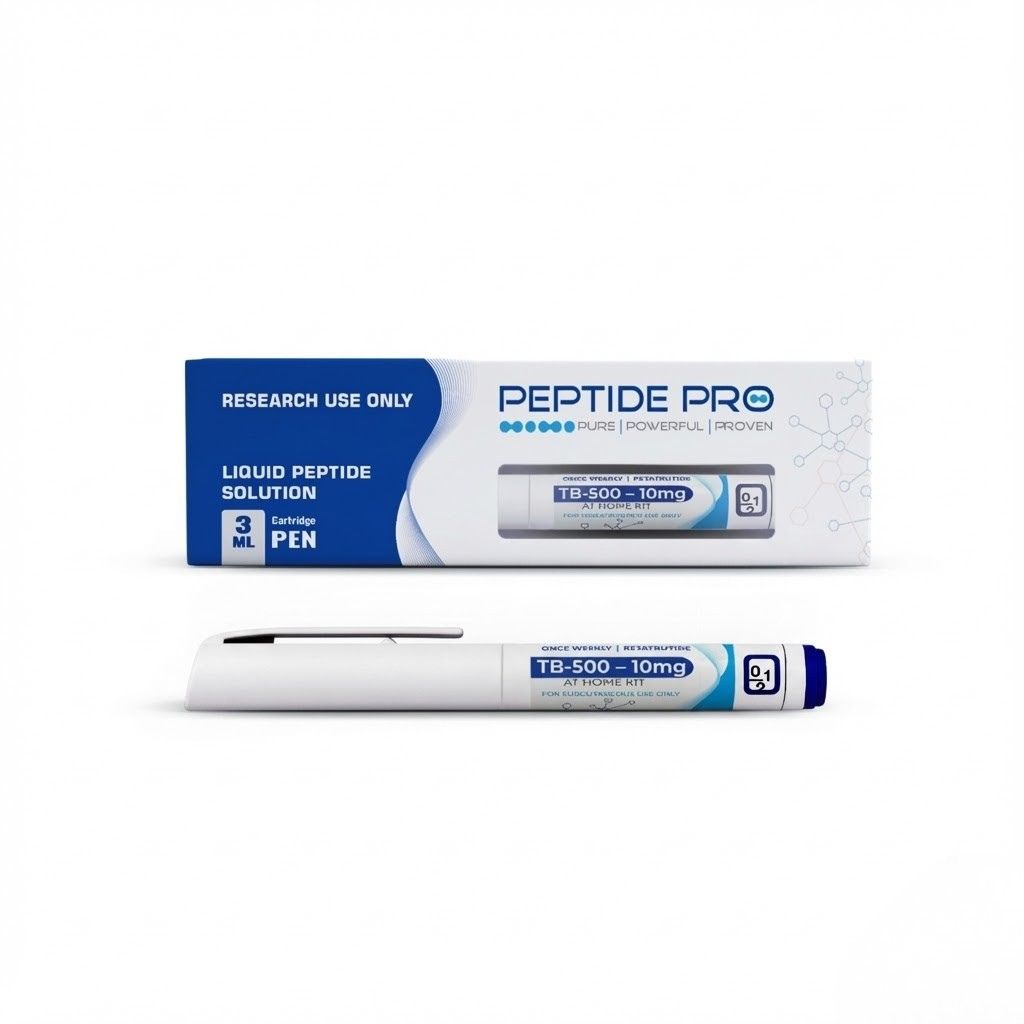
TB-500 10mg: https://www.peptidepro.co.uk/product/tb-500-10mg/ (For actin-mediated cell migration research).
BPC-157 10mg: (For research into angiogenic repair of soft tissue).
This product is strictly for Research Use Only (RUO). It is not intended for human consumption, injection, therapeutic use (e.g., for treating diabetic ulcers or infections), or diagnostic procedures. The information provided is for educational and scientific reference only. Purchase is restricted to verified research institutions and qualified individuals. Any evidence of intended misuse for human application will result in immediate order cancellation and blacklisting, in compliance with UK research chemical regulations.
Explore our high-purity compounds — including Retatide (Retatrutide 30 mg), Semaglutide, and more.
Fast UK shipping. Lab-tested quality. Strictly for research use only.