
| Specification | Detail |
| Category | Oncology & Membrane Biophysics Research |
| Product Name | PNC-27 (p53-Penetratin Chimera) |
| Quantity | 10mg (Total Active API) |
| Formulation | Sterile Lyophilised Solution in Bacteriostatic Water |
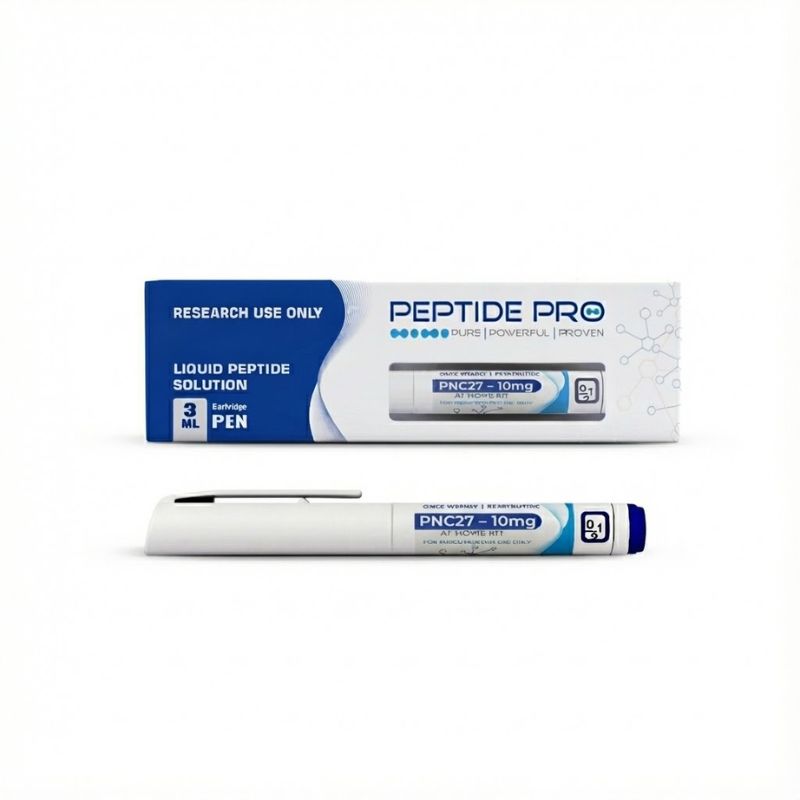
| Delivery Method | 3ml Precision Reconstituted Pen |
| Sequence | Pro-Pro-Leu-Ser-Qln-Glu-Thr-Phe-Ser-Asp-Leu-Trp-Lys-Leu-Leu-Pro + Penetratin |
| Molecular Formula | $C_{188}H_{293}N_{53}O_{44}S$ |
| Molecular Weight | $\approx 4031.7 \text{ g/mol}$ |
| Purity | >98% (HPLC Analysis) |
£129.00
Abstract The PNC-27 10mg peptide pen contains a synthetic chimeric peptide derived from the p53 tumour suppressor protein. Structurally, it fuses the HDM2-binding domain of p53 (residues 12–26) with a transmembrane-penetrating sequence (penetratin) derived from the Drosophila Antennapedia homeodomain. This compound is a primary reagent in oncology research, specifically utilised to investigate membrane biophysics and non-apoptotic cell death pathways in malignant cell lines. Unlike traditional chemotherapeutics that target DNA replication, PNC-27 is researched for its ability to interact selectively with HDM2 (MDM2) expressed on the plasma membrane of tumour cells, inducing transmembrane pore formation and subsequent necrotic osteolysis. This 10mg precision pen allows for the rigorous study of membranolysis kinetics and the selectivity profile between untransformed and transformed cellular phenotypes.
Primary Biological Pathway: HDM2-Mediated Membranolysis The definitive mechanism of PNC-27 is its interaction with the protein HDM2 (the human homolog of MDM2). In healthy cells, HDM2 is primarily nuclear and regulates p53 stability. However, research indicates that in many cancer cell lines, a distinct isoform of HDM2 is overexpressed on the external plasma membrane. PNC-27 binds to this extranuclear HDM2 via its p53-mimetic domain. This binding event induces a conformational change in the peptide, allowing it to assemble into oligomeric pores within the membrane. These pores disrupt the osmotic balance of the cell, leading to rapid membranolysis and necrotic cell death, a pathway distinct from caspase-dependent apoptosis.
Secondary Research Finding: Selectivity and Safety Ratios A critical area of investigation is the peptide’s selectivity. Studies utilising the 10mg format focus on comparing the cytotoxicity of PNC-27 in transformed (cancerous) cells versus non-transformed (healthy) epithelial or endothelial cells. The hypothesis is that healthy cells, lacking high concentrations of membrane-bound HDM2, do not facilitate the pore-forming conformation of the peptide. Researchers use this compound to establish “therapeutic indices” in vitro, measuring lactate dehydrogenase (LDH) release as a marker of membrane integrity to quantify the specificity of the lytic effect.
Tertiary Research Finding: Independence from p53 Status Unlike many therapeutics that rely on a functional p53 pathway to trigger apoptosis, PNC-27 appears to be effective regardless of the cell’s p53 mutational status. Because the mechanism is physical (membrane disruption) rather than genomic (DNA damage signalling), it is heavily researched in cell lines that are homozygous null for p53 or contain dominant-negative mutations. This makes PNC-27 a valuable tool for researching “drug-resistant” phenotypes that typically evade standard apoptotic triggers.
Long-term Genomic and Safety Observations While the primary effect is biophysical, researchers are also monitoring downstream genomic responses. In bystander cells (healthy cells exposed to the peptide), transcriptomic analysis is conducted to ensure that PNC-27 does not trigger an inflammatory cytokine storm or stress-response genes (HSP70). The 10mg pen allows for controlled dosing to verify that the peptide remains inert in the absence of its specific membrane target, a crucial safety parameter for developing targeted membrane-active agents.
Purity: Validated at >98+% via High-Performance Liquid Chromatography (HPLC). The chimeric sequence is rigorously verified to ensure the penetratin domain is correctly fused to the p53 domain, which is essential for cell surface adherence.
Appearance: The 3ml pen contains a clear, colourless, sterile liquid.
Precision: The pen delivery system allows for the administration of precise micro-molar concentrations. This is vital for determining IC50 values in cell viability assays (e.g., MTT or Crystal Violet assays).
Storage: The product must be stored at 2∘C to 8∘C.
Refrigeration and Shelf Life The PNC-27 10mg Pen contains a complex long-chain peptide that is susceptible to unfolding. It must be refrigerated (2∘C to 8∘C). The shelf life is 12 months in the sealed state. Once the pen is opened, the bacteriostatic environment preserves the solution for 28 days. Researchers should be aware that peptides containing tryptophan and methionine residues (present in the sequence) are prone to oxidation; therefore, keeping the cap secured and the pen refrigerated is mandatory to preserve the HDM2-binding affinity.
Shipping Stability We utilise medical-grade thermal packaging. The peptide is stable for up to 72 hours at ambient UK temperatures. However, to maintain the precise secondary structure required for pore formation, we recommend selecting the fastest shipping option (Next Day Delivery).
Freezing Warning Do not freeze. Freezing can cause the peptide to aggregate into amyloid-like fibrils. Upon thawing, these aggregates will not dissolve and will fail to form the structured pores necessary for its mechanism of action. Using frozen/thawed PNC-27 will likely result in false-negative cytotoxicity data.
The PNC-27 10mg Pen is the standard for Cytotoxicity and Membrane Assays. Research into membranolytic peptides requires exact dosing; a slightly lower concentration may fail to form pores, while a slightly higher concentration could cause non-specific lysis. Manual reconstitution of PNC-27 powder often leads to concentration errors that skew IC50 curves.
Our pre-reconstituted pen ensures a verified, homogeneous concentration. This allows researchers to add specific volumes to cell culture media with confidence, knowing the molarity is accurate for meaningful comparative analysis against other cytotoxic agents.
For researchers investigating cellular health and repair mechanisms (as controls or counter-studies), we recommend examining:
SS-31 10mg: (For research into mitochondrial protection and cell survival).
Thymulin 10mg: (For research into immune-mediated cell differentiation).
This product is strictly for Research Use Only (RUO). It is not intended for human consumption, injection, therapeutic use (e.g., as a cancer treatment), or diagnostic procedures. The claims regarding membranolysis are based on in vitro laboratory models. Purchase is restricted to verified research institutions and qualified individuals. Any evidence of intended misuse for human application will result in immediate order cancellation and blacklisting, in compliance with UK research chemical regulations.
Explore our high-purity compounds — including Retatide (Retatrutide 30 mg), Semaglutide, and more.
Fast UK shipping. Lab-tested quality. Strictly for research use only.