
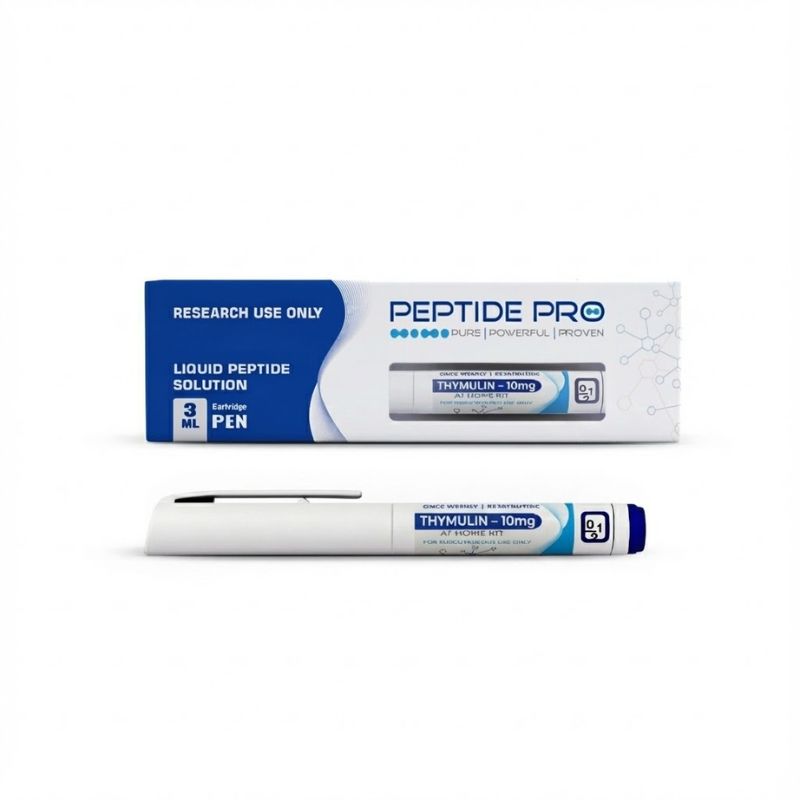
| Specification | Detail |
| Category | Immunology & Neuroendocrine Research |
| Product Name | Thymulin (Zinc-Facteur Thymique Sérique) |
| Quantity | 10mg (Total Active Zn-FTS Complex) |
| Formulation | Sterile Lyophilised Solution in Bacteriostatic Water |
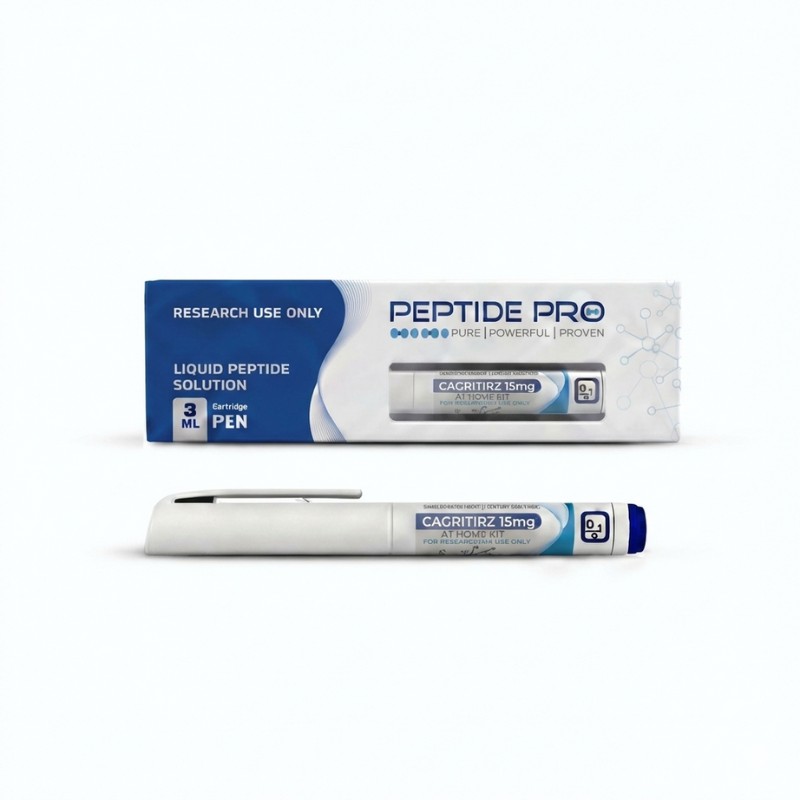
| Delivery Method | 3ml Precision Reconstituted Pen |
| CAS Number | 63958-90-7 (FTS sequence) / 75640-39-2 (Zn Complex) |
| Molecular Formula | $C_{33}H_{54}N_{12}O_{15} \cdot Zn^{2+}$ |
| Molecular Weight | $\approx 858.9 \text{ g/mol}$ (Peptide Base) + Zinc Ion |
| Purity | >98% (HPLC Analysis) |
£129.00
Abstract The Thymulin 10mg peptide pen features a highly purified synthesis of the nonapeptide hormone originally characterised as “Serum Thymic Factor” (FTS). Crucially, this formulation includes the zinc-bound complex (Zn−FTS) required for biological activity. Produced naturally by the thymic epithelial cells, Thymulin is a cornerstone reagent for immunologists investigating T-cell differentiation and the neuroendocrine regulation of the immune system. Unlike other thymic peptides that function primarily as precursors, Thymulin acts directly at the receptor level to induce the expression of specific T-cell markers. This 10mg precision pen allows researchers to investigate the zinc-dependent modulation of inflammation and hyperalgesia (pain sensitivity) with a degree of dosing accuracy that is essential for delineating its pleiotropic effects.
Primary Biological Pathway: T-Cell Differentiation and Maturation Thymulin is the primary subject of research concerning the extrathymic maturation of T-lymphocytes. The nonapeptide sequence requires a stoichiometric interaction with a zinc ion (Zn2+) to adopt the biologically active conformation necessary to bind to high-affinity receptors on T-cells. Once bound, Thymulin triggers a signalling cascade (via cyclic AMP) that induces the expression of differentiation markers such as Thy-1, CD3, and CD4/CD8 on immature thymocytes. Researchers utilise the 10mg pen to study “immune senescence,” specifically investigating whether exogenous Thymulin administration can restore T-cell competence in aged animal models where thymic involution has occurred.
Secondary Research Finding: The Neuro-Immune Axis and Hyperalgesia A rapidly expanding field of inquiry involves Thymulin’s role as a neuropeptide. It has been observed to possess potent analgesic and anti-inflammatory properties, specifically in models of neurogenic pain and hyperalgesia. Research indicates that Thymulin acts on the afferent sensory neurons to downregulate the release of pro-inflammatory neuropeptides like Substance P. The 10mg formulation is frequently employed in studies of autoimmune neuritis to determine if the peptide can mitigate cytokine-induced pain hypersensitivity (allodynia) through the pituitary-adrenal axis.
Tertiary Research Finding: Pituitary Feedback Loops Thymulin demonstrates a unique bidirectional relationship with the endocrine system. It stimulates the release of luteinising hormone (LH) and adrenocorticotropic hormone (ACTH) from the pituitary gland. Conversely, its own secretion is regulated by thyroxine and prolactin. Researchers are using this compound to map the “thymus-pituitary feedback loop,” aiming to understand how stress hormones suppress immune function and whether Thymulin supplementation can break this cycle during chronic physiological stress.
Long-term Genomic and Safety Observations Current longitudinal studies are analysing the impact of Thymulin on the genomic stability of hematopoietic stem cells. Given its role in cell differentiation, ensuring that it does not induce aberrant proliferation is a key safety parameter. Preliminary transcriptomic data suggests that Thymulin upregulation of the Il2ra gene (Interleukin-2 receptor alpha) is highly specific to T-lineage cells, limiting “off-target” effects on other tissue types.
Purity: Validated at >98% via High-Performance Liquid Chromatography (HPLC). We strictly control the Zinc:Peptide molar ratio during synthesis to ensure the complex is fully active upon reconstitution.
Appearance: The 3ml pen contains a clear, colourless, sterile liquid.
Precision: The pen device ensures consistent volumetric delivery, which is critical given that Thymulin exhibits a bell-shaped dose-response curve (hormetic effect), where overdose can diminish efficacy.
Storage: The product must be maintained at 2∘C to 8∘C.
Refrigeration and Shelf Life The Thymulin 10mg Pen is a zinc-metallopeptide and is sensitive to chelation and thermal degradation. It must be stored in a refrigerator (2∘C to 8∘C). The shelf life is 12 months in the sealed state. Once the pen is used, the bacteriostatic environment preserves the solution for 28 days. Researchers should be aware that the zinc ion can dissociate if the solution is subjected to extreme pH changes; therefore, mixing with other unverified reagents is discouraged.
Shipping Stability We utilise medical-grade thermal packaging. The peptide is stable for up to 72 hours at ambient UK temperatures. However, to preserve the coordinate bond between the zinc ion and the peptide backbone, we recommend selecting the fastest shipping option available.
Freezing Warning Do not freeze. Freezing can disrupt the non-covalent bond between the peptide and the zinc ion. Upon thawing, the peptide may not re-complex efficiently with the metal ion, rendering it biologically inactive (returning it to the inert FTS state). A frozen pen should be discarded.
The Thymulin 10mg Pen solves a specific chemical challenge: Zinc Stoichiometry. Preparing biologically active Thymulin from raw powder requires precise chelation with zinc salts in a specific buffer. If the ratio is incorrect, the peptide remains inert FTS.
Our pre-formulated pen contains the pre-complexed Zn−FTS molecule in a stabilised solution. This guarantees that the reagent is immediately bioactive upon administration, eliminating the complex chemistry required at the benchside. It ensures that your immunology data reflects the true activity of the hormone, not a preparation error.
For researchers investigating related immune and regenerative pathways, we recommend examining:
TB-500 10mg: https://www.peptidepro.co.uk/product/tb-500-10mg/ (For Thymosin Beta-4 mediated tissue repair).
VIP 10mg: https://www.peptidepro.co.uk/product/vip-10mg/ (For comparative neuro-immune modulation).
This product is strictly for Research Use Only (RUO). It is not intended for human consumption, injection, therapeutic use, or diagnostic procedures. The information provided is for educational and scientific reference only. Purchase is restricted to verified research institutions and qualified individuals. Any evidence of intended misuse for human application will result in immediate order cancellation and blacklisting, in compliance with UK research chemical regulations.
Explore our high-purity compounds — including Retatide (Retatrutide 30 mg), Semaglutide, and more.
Fast UK shipping. Lab-tested quality. Strictly for research use only.