
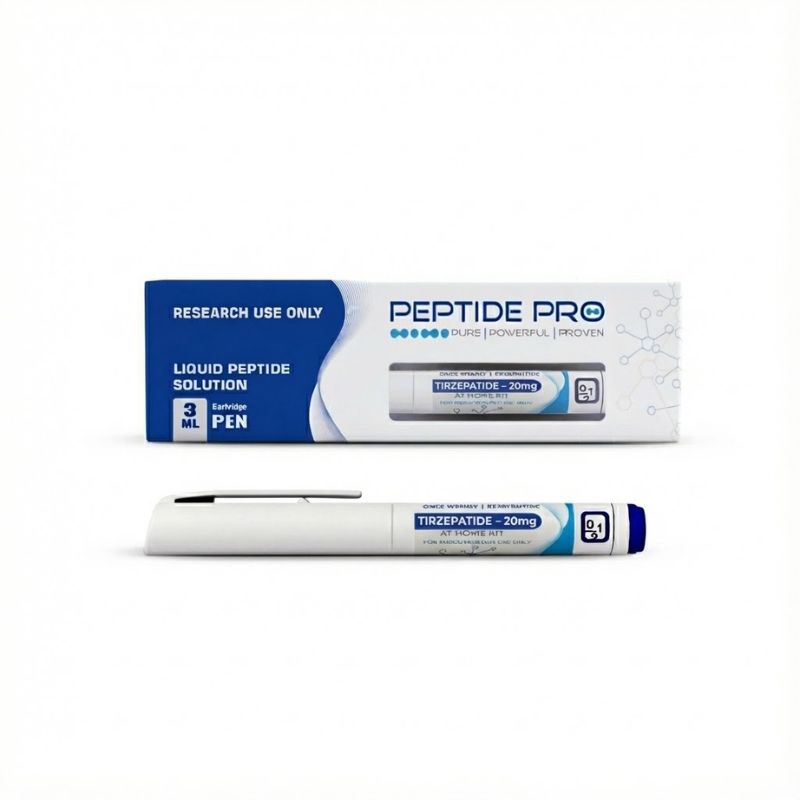
| Specification | Detail |
| Category | Dual Incretin Agonist Research |
| Product Name | Tirzepatide (GIP/GLP-1 Receptor Agonist) |
| Quantity | 20mg (Total Active API Concentration) |
| Formulation | Sterile Lyophilised Solution in Bacteriostatic Water |
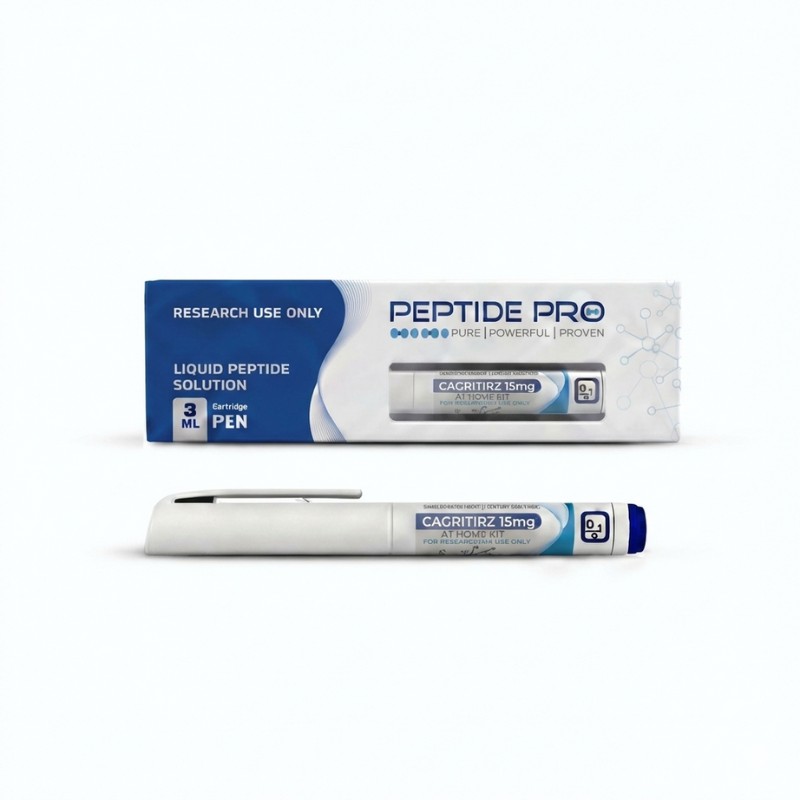
| Delivery Method | 3ml Precision Reconstituted Pen |
| CAS Number | 2023788-19-2 |
| Molecular Formula | $C_{225}H_{348}N_{48}O_{68}$ |
| Molecular Weight | $\approx 4813.52 \text{ g/mol}$ |
| Purity | >99% (HPLC Analysis) |
£179.00
Abstract The Tirzepatide 20mg peptide pen acts as a fundamental research tool for investigating the early-stage physiological responses to dual incretin agonism. Comprising a single peptide molecule that simultaneously activates Glucose-dependent Insulinotropic Polypeptide (GIP) and Glucagon-like Peptide-1 (GLP-1) receptors, this formulation is specifically optimised for “step-up” titration protocols and moderate-dose metabolic studies. The 20mg concentration allows researchers to observe the distinct separation between the GLP-1 mediated effects (satiety, gastric slowing) and the emerging GIP-mediated effects (lipid handling, insulin potentiation) without the confounding variables of high-dose receptor saturation. It is an essential reagent for establishing the minimum effective dose (MED) in models of early-onset metabolic syndrome.
Primary Biological Pathway: Establishing Receptor Selectivity The 20mg formulation is pivotal for research focusing on the biased nature of Tirzepatide’s binding affinity. At this moderate concentration, the peptide activates GIP receptors to a significantly higher degree than GLP-1 receptors. This “imbalance” is a key subject of study. Researchers use the 20mg dose to isolate the GIP-specific contribution to glucose homeostasis, specifically testing the hypothesis that GIP agonism improves beta-cell function and insulin sensitivity before significant weight loss occurs, a phenomenon less observable at higher, weight-loss-driving doses.
Secondary Research Finding: Gastric Motility Adaptation A critical barrier in incretin research is gastrointestinal intolerance. The 20mg pen allows for the investigation of gastric adaptation mechanisms. Studies utilising this concentration measure the rate of gastric emptying decay—how quickly the stomach “learns” to tolerate the delay in transit. This data is vital for designing titration schedules that maximise therapeutic windows while minimising stress-induced adverse events (nausea/pica) in animal models.
Tertiary Research Finding: Renal Haemodynamics Emerging research suggests that GIP/GLP-1 agonists may have renoprotective effects. The 20mg concentration is frequently employed in models of diabetic nephropathy to assess changes in glomerular filtration rate (GFR) and urinary albumin excretion. The hypothesis is that the peptide reduces renal oxidative stress and inflammation via endothelial GIP receptors. This dose provides a stable platform for long-term renal observation without the potential dehydration risks associated with the rapid weight loss of higher doses.
Long-term Genomic and Safety Observations Genomic stability studies at the 20mg level often focus on the expression of Pcsk9 and other lipid-regulating genes in the liver. Researchers are documenting whether moderate-dose dual agonism is sufficient to permanently alter the transcriptional landscape of cholesterol metabolism, or if continuous high-dose administration is required. Preliminary data suggests that the 20mg dose may be the “genomic threshold” for activating these beneficial hepatic pathways.
Purity: Validated at >98+% via High-Performance Liquid Chromatography (HPLC). The synthesis is rigorously controlled to prevent the formation of beta-sheet aggregates which can occur during the acylation process.
Appearance: The 3ml pen contains a clear, colourless, sterile liquid.
Precision: The pen utilises a micro-click mechanism, ensuring precise delivery of small volumes (e.g., 0.5mg or 1mg increments), which is essential for fine-tuning titration steps.
Storage: The product must be stored at 2∘C to 8∘C to maintain bioactivity.
Refrigeration and Shelf Life The Tirzepatide 20mg Pen is a sensitive biological reagent. It requires continuous refrigeration (2∘C to 8∘C). The shelf life is 12 months in the sealed state. Once the pen is used for an experiment, the bacteriostatic seal ensures stability for 28 days. Researchers are strongly advised to plan their protocols to consume the reagent within this timeframe to ensure that the dose-response data remains valid.
Shipping Stability This product ships with advanced thermal protection. The peptide is formulated to withstand ambient temperatures for up to 72 hours during UK transit. However, to preserve the precise tertiary structure required for dual-receptor binding, we recommend prioritising expedited shipping.
Freezing Warning Do not freeze. Freezing will cause the water in the solution to crystallise, leading to the physical shearing of the peptide bonds (denaturation). This results in irreversible precipitation and a loss of potency. A frozen pen is effectively ruined and should be discarded.
The Tirzepatide 20mg Pen is the definitive tool for Intermediate Titration. In sophisticated metabolic studies, moving from an induction dose (e.g., 10mg) directly to a maintenance dose (e.g., 40mg+) often causes study drop-outs due to adverse events. The 20mg pen bridges this gap.
It offers a pre-formulated, sterile solution that allows researchers to implement a smooth, linear titration curve. This ensures that subject retention is maximised and that the data reflects true metabolic adaptation rather than stress responses.
For researchers designing a complete stepwise protocol, we recommend the following sequence:
Step 1 (Induction): Tirzepatide 15mg
Step 2 (Current): Tirzepatide 20mg
Step 3 (Escalation): Tirzepatide 30mg
This product is strictly for Research Use Only (RUO). It is not intended for human consumption, injection, therapeutic use, or diagnostic procedures. The information provided is for educational and scientific reference only. Purchase is restricted to verified research institutions and qualified individuals. Any evidence of intended misuse for human application will result in immediate order cancellation and blacklisting, in compliance with UK research chemical regulations.
Explore our high-purity compounds — including Retatide (Retatrutide 30 mg), Semaglutide, and more.
Fast UK shipping. Lab-tested quality. Strictly for research use only.