

Precision matters in peptide research—especially when working with novel compounds like retatrutide. A single miscalculation between milligrams and insulin syringe units can compromise an entire research protocol, waste valuable materials, and produce unreliable data. For researchers and laboratory professionals working with this triple agonist peptide in 2025, understanding how to accurately convert between measurement systems isn’t just helpful—it’s essential.
The Retatrutide Dosage Calculator (mg ⇄ units) serves as a critical tool for ensuring measurement accuracy when reconstituting and administering this research peptide. Whether you’re establishing protocols for metabolic studies or conducting comparative analyses, mastering these conversion principles will enhance the reliability and reproducibility of your research outcomes.
Key Takeaways
- Accurate conversion between mg and units depends entirely on your reconstitution concentration—there is no universal conversion factor
- The fundamental formula is: Units = (Desired mg × Total Volume in ml × 100) ÷ Total mg in pen peptide
- Standard insulin syringes measure in units (typically 100 units per 1ml), requiring precise calculation for peptide extraction
- Reconstitution concentration directly impacts dosing accuracy—always document your bacteriostatic water volume
- Verification and double-checking calculations prevents costly research errors and ensures protocol consistency
Understanding Retatrutide: The Triple Agonist Peptide
Retatrutide represents a significant advancement in peptide research, functioning as a triple agonist targeting GIP (glucose-dependent insulinotropic polypeptide), GLP-1 (glucagon-like peptide-1), and glucagon receptors simultaneously. This unique mechanism of action has positioned it as a compound of considerable interest in metabolic research throughout 2025.
Molecular Characteristics
As a synthetic peptide, retatrutide is supplied in lyophilized (freeze-dried) powder form, requiring reconstitution with bacteriostatic water before use in research applications. The compound is typically available in various concentrations:
- 10mg pen peptides – suitable for smaller-scale studies
- 30mg pen peptides – common for extended research protocols
- 40mg pen peptides – optimal for larger laboratory applications
At PEPTIDE PRO, research-grade retatrutide is supplied with full documentation, certificates of analysis, and strict quality controls to ensure consistency across batches.
Why Measurement Precision Matters
Unlike some research compounds measured by volume alone, peptides require dual consideration of both mass (milligrams) and volume (units or milliliters). This dual measurement system creates the necessity for accurate conversion calculations, particularly when:
- Establishing dose-response curves in metabolic studies
- Maintaining consistency across multi-week research protocols
- Comparing results with published literature using different measurement standards
- Scaling protocols from preliminary to full-scale investigations
“In peptide research, measurement accuracy isn’t negotiable—it’s the foundation upon which reliable, reproducible results are built.”
The Science Behind the Retatrutide Dosage Calculator (mg ⇄ units)
Understanding the mathematical relationship between milligrams and units requires grasping three fundamental concepts: concentration, volume, and the standardization of insulin syringes.
The Concentration Principle
When you reconstitute lyophilized retatrutide, you create a solution with a specific concentration—the amount of peptide (in mg) per unit volume (in ml). This concentration becomes the cornerstone of all subsequent calculations.
Example concentration calculations:
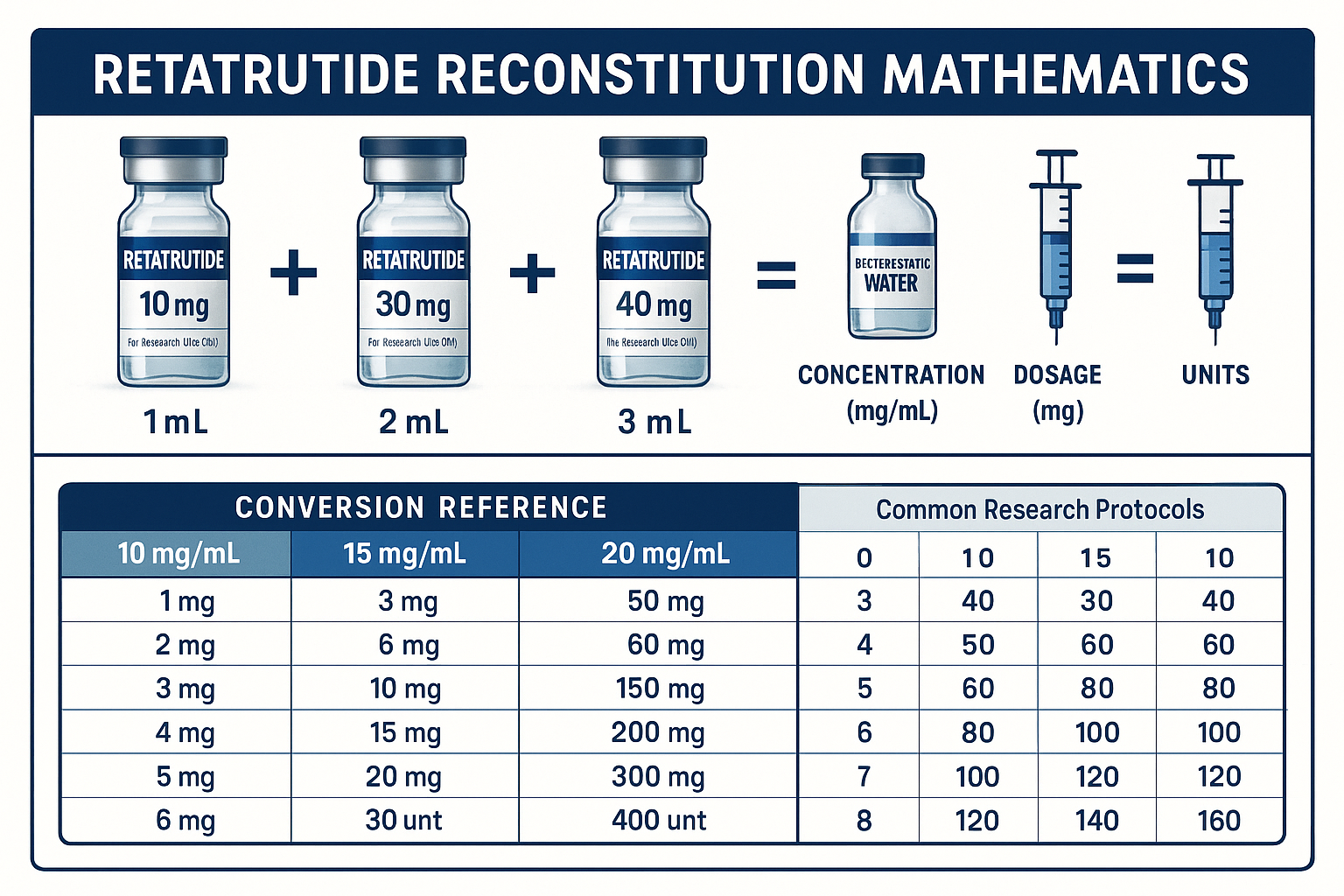
| Vial Size | Bacteriostatic Water Added | Resulting Concentration |
|---|---|---|
| 10mg | 1ml | 10mg/ml |
| 10mg | 2ml | 5mg/ml |
| 30mg | 2ml | 15mg/ml |
| 30mg | 3ml | 10mg/ml |
| 40mg | 2ml | 20mg/ml |
| 40mg | 4ml | 10mg/ml |
The concentration you choose directly impacts how many units on an insulin syringe correspond to each milligram of retatrutide. There is no universal conversion—it must be calculated for your specific reconstitution.
Understanding Insulin Syringe Units
Standard insulin syringes are calibrated in units, with the most common being U-100 syringes (100 units = 1ml). This standardization allows for precise measurement of small volumes:
- 100 units = 1ml = 1000μl
- 50 units = 0.5ml = 500μl
- 10 units = 0.1ml = 100μl
- 1 unit = 0.01ml = 10μl
When working with research peptides, this unit system provides the precision necessary for accurate dosing, particularly when dealing with milligram quantities that would be difficult to measure volumetrically.
The Core Conversion Formula
The Retatrutide Dosage Calculator (mg ⇄ units) relies on this essential formula:
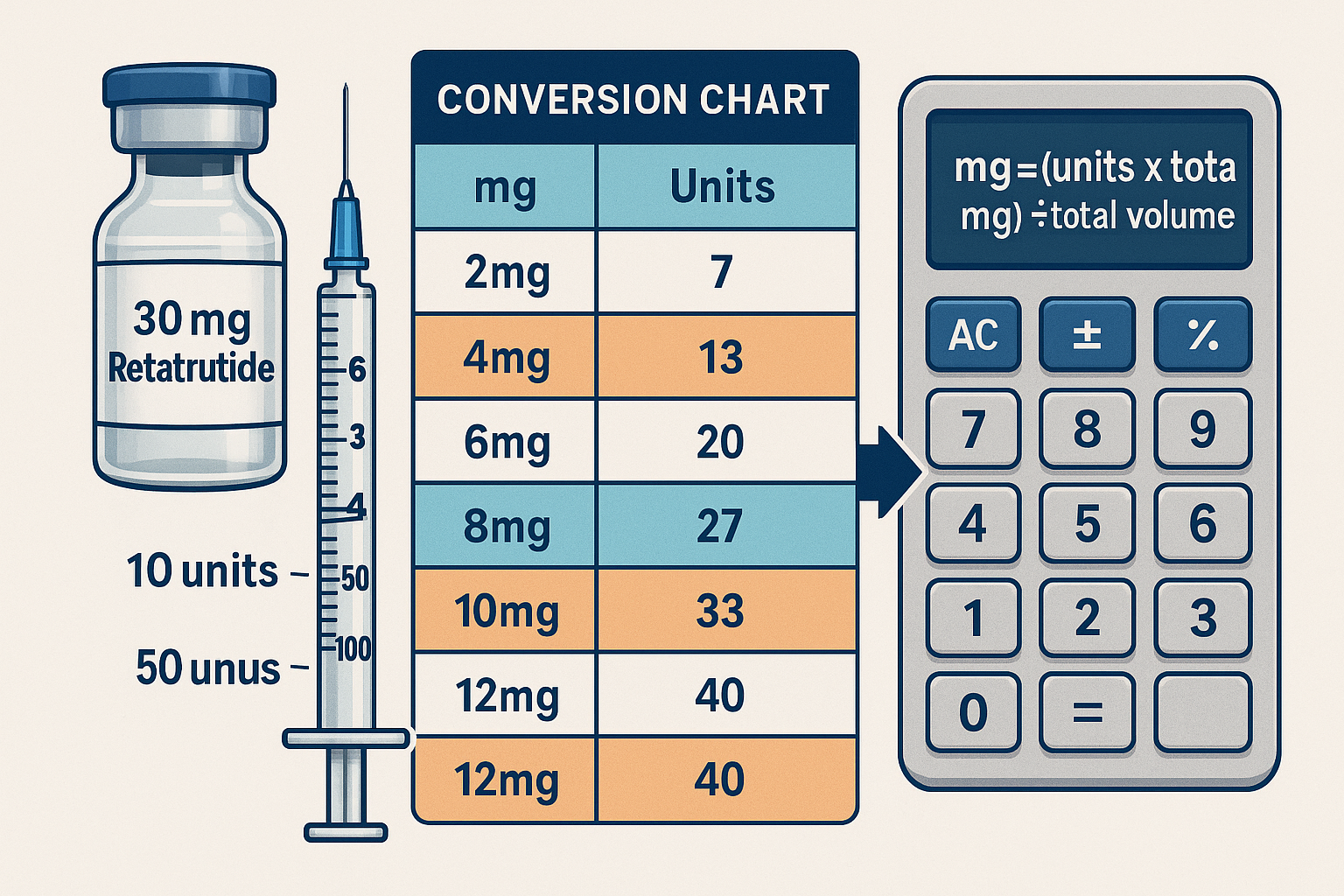
Units = (Desired mg × Total Volume in ml × 100) ÷ Total mg in pen peptide
Let’s break this down with a practical example:
📊 Scenario: You have a 30mg pen peptide of retatrutide reconstituted with 2ml of bacteriostatic water, and you need to extract 6mg for your research protocol.
Calculation:
- Desired dose: 6mg
- Total peptide in pen peptide: 30mg
- Total volume: 2ml
- Formula: (6 × 2 × 100) ÷ 30 = 1200 ÷ 30 = 40 units
Therefore, drawing 40 units on your insulin syringe will deliver exactly 6mg of retatrutide.
Reverse Calculation: Units to Milligrams
You can also reverse the formula to determine how many milligrams are in a given number of units:
mg = (Units × Total mg in pen peptide) ÷ (Total Volume in ml × 100)
📊 Example: Using the same 30mg pen peptide reconstituted with 2ml, if you draw 25 units:
Calculation:
- Units drawn: 25
- Total peptide: 30mg
- Total volume: 2ml
- Formula: (25 × 30) ÷ (2 × 100) = 750 ÷ 200 = 3.75mg
Step-by-Step Guide: Using a Retatrutide Dosage Calculator (mg ⇄ units)
Implementing accurate dosage calculations in your research workflow requires a systematic approach. Follow these detailed steps to ensure precision and consistency.
Step 1: Document Your Reconstitution Parameters
Before any calculations, record these critical variables:
✅ Total peptide mass (printed on pen peptide label—e.g., 10mg, 30mg, 40mg)
✅ Bacteriostatic water volume you will add (your choice—typically 1-4ml)
✅ Resulting concentration (calculated as mg ÷ ml)
✅ Date of reconstitution (for stability tracking)
✅ Batch number (for research documentation)
When sourcing research peptides from our shop, each pen peptide includes comprehensive labeling with exact peptide content and batch information for complete traceability.
Step 2: Calculate Your Concentration
Concentration (mg/ml) = Total mg in pen peptide ÷ Volume of water added (ml)
This concentration becomes your reference point for all subsequent dosing calculations.
Step 3: Determine Required Dosage in Milligrams
Based on your research protocol, identify the exact milligram dose required. Common research dosages for retatrutide studies range from 0.5mg to 12mg, though this varies significantly based on study design and objectives.
Step 4: Apply the Conversion Formula
Use the core formula to convert your desired milligram dose to insulin syringe units:
Units = (Desired mg × Total Volume ml × 100) ÷ Total mg
Step 5: Verify Your Calculation
Always double-check your mathematics using the reverse formula to confirm accuracy:
mg = (Units × Total mg) ÷ (Total Volume × 100)
If the result matches your intended dose, proceed with confidence.
Step 6: Extract and Document
Using a sterile insulin syringe, carefully extract the calculated number of units. Document:
- Date and time of extraction
- Units drawn
- Corresponding mg dose
- Vial identification
- Remaining volume in pen peptide
Comprehensive Conversion Tables for Common Retatrutide Concentrations
To streamline your research workflow, reference these pre-calculated conversion tables for the most common reconstitution scenarios.
30mg Vial + 2ml Bacteriostatic Water (15mg/ml concentration)
| Desired Dose (mg) | Units to Draw | Volume (ml) |
|---|---|---|
| 0.5mg | 6.67 units | 0.067ml |
| 1mg | 13.33 units | 0.133ml |
| 2mg | 26.67 units | 0.267ml |
| 3mg | 40 units | 0.4ml |
| 4mg | 53.33 units | 0.533ml |
| 5mg | 66.67 units | 0.667ml |
| 6mg | 80 units | 0.8ml |
| 8mg | 106.67 units* | 1.067ml* |
| 10mg | 133.33 units* | 1.333ml* |
| 12mg | 160 units* | 1.6ml* |
*Note: Doses requiring more than 100 units exceed standard U-100 syringe capacity and require multiple draws or larger syringes.
30mg Vial + 3ml Bacteriostatic Water (10mg/ml concentration)
| Desired Dose (mg) | Units to Draw | Volume (ml) |
|---|---|---|
| 0.5mg | 5 units | 0.05ml |
| 1mg | 10 units | 0.1ml |
| 2mg | 20 units | 0.2ml |
| 3mg | 30 units | 0.3ml |
| 4mg | 40 units | 0.4ml |
| 5mg | 50 units | 0.5ml |
| 6mg | 60 units | 0.6ml |
| 8mg | 80 units | 0.8ml |
| 10mg | 100 units | 1.0ml |
| 12mg | 120 units* | 1.2ml* |
40mg Vial + 2ml Bacteriostatic Water (20mg/ml concentration)
| Desired Dose (mg) | Units to Draw | Volume (ml) |
|---|---|---|
| 1mg | 10 units | 0.1ml |
| 2mg | 20 units | 0.2ml |
| 4mg | 40 units | 0.4ml |
| 6mg | 60 units | 0.6ml |
| 8mg | 80 units | 0.8ml |
| 10mg | 100 units | 1.0ml |
| 12mg | 120 units* | 1.2ml* |
10mg Vial + 1ml Bacteriostatic Water (10mg/ml concentration)
| Desired Dose (mg) | Units to Draw | Volume (ml) |
|---|---|---|
| 0.25mg | 2.5 units | 0.025ml |
| 0.5mg | 5 units | 0.05ml |
| 1mg | 10 units | 0.1ml |
| 2mg | 20 units | 0.2ml |
| 3mg | 30 units | 0.3ml |
| 4mg | 40 units | 0.4ml |
| 5mg | 50 units | 0.5ml |
Common Calculation Errors and How to Avoid Them
Even experienced researchers can fall victim to conversion errors. Understanding these common pitfalls helps maintain protocol integrity.
❌ Error #1: Assuming Universal Conversion Factors
The Mistake: Using a conversion chart from a different reconstitution concentration.
Why It Fails: A 30mg pen peptide reconstituted with 2ml has a completely different mg-per-unit ratio than the same pen peptide reconstituted with 3ml.
The Solution: Always calculate conversions based on YOUR specific reconstitution parameters. Never use someone else’s conversion table unless the concentration exactly matches.
❌ Error #2: Confusing Total Vial Content with Remaining Content
The Mistake: Recalculating the conversion formula after each extraction based on “remaining” peptide.
Why It Fails: The concentration remains constant throughout the pen peptide’s use. If you started with 30mg in 2ml (15mg/ml), that concentration doesn’t change when you’ve used half the pen peptide—you simply have less total volume.
The Solution: Use the ORIGINAL total mg and total volume for all calculations throughout the pen peptide’s lifespan. Track remaining volume separately for inventory purposes.
❌ Error #3: Rounding Too Aggressively
The Mistake: Rounding 6.67 units to 7 units, or 13.33 units to 13 units.
Why It Fails: In peptide research, these small differences accumulate and can significantly impact dose-dependent outcomes.
The Solution: Use insulin syringes with fine gradation marks (0.5 unit increments) and measure as precisely as possible. When exact measurement isn’t feasible, always round conservatively and document the actual dose delivered.
❌ Error #4: Neglecting Dead Volume
The Mistake: Assuming you can extract every drop from a pen peptide.
Why It Fails: Standard pen peptides retain approximately 0.1-0.2ml of “dead volume” that cannot be practically extracted.
The Solution: When planning multi-dose protocols, account for 5-10% loss to dead volume. If you need exactly 10 doses of 3mg from a 30mg pen peptide, consider slight over-reconstitution or accept that the final dose may be incomplete.
❌ Error #5: Mixing Measurement Systems Mid-Protocol
The Mistake: Switching between mg measurements and unit measurements without recalculating.
Why It Fails: Inconsistent measurement introduces variables that compromise data integrity.
The Solution: Choose one measurement system (preferably mg for scientific documentation) and stick with it throughout your research protocol. Use the Retatrutide Dosage Calculator (mg ⇄ units) to convert as needed, but maintain consistent documentation standards.
Best Practices for Retatrutide Reconstitution and Measurement
Achieving calculation accuracy is only part of the equation. Proper handling, reconstitution, and measurement techniques ensure your calculations translate to actual dosing precision.
🔬 Reconstitution Protocol
Materials Required:
- Lyophilized retatrutide pen peptide (from a trusted source like PEPTIDE PRO)
- Bacteriostatic water (0.9% benzyl alcohol)
- Alcohol swabs
- Sterile syringes (3ml or 5ml for reconstitution)
- Insulin syringes (U-100, 0.5ml or 1ml capacity)
Procedure:
- Equilibrate temperature: Allow both peptide pen peptide and bacteriostatic water to reach room temperature (approximately 30 minutes)
- Sanitize: Wipe both pen peptide stoppers with alcohol swabs and allow to air dry
- Calculate volume: Determine your desired final concentration and corresponding bacteriostatic water volume
- Draw water: Using a sterile syringe, draw the calculated volume of bacteriostatic water
- Inject slowly: Insert needle into peptide pen peptide at an angle, directing water flow against the glass wall—NOT directly onto the powder
- Gentle mixing: Swirl gently in circular motions. NEVER shake vigorously, as this can denature the peptide
- Visual inspection: Ensure complete dissolution. Solution should be clear and free of particulates
- Label clearly: Mark the pen peptide with reconstitution date, concentration, and batch number
- Store properly: Refrigerate immediately at 2-8°C (never freeze reconstituted peptides)
📏 Measurement Best Practices
Syringe Selection:
- Use U-100 insulin syringes for doses under 1ml
- Choose 0.5ml syringes for doses under 50 units (better precision)
- Select syringes with 0.5-unit gradation marks when possible
Extraction Technique:
- Sanitize pen peptide stopper before each extraction
- Draw air into syringe equal to dose volume
- Inject air into pen peptide to equalize pressure
- Invert pen peptide and draw slightly more than needed
- Tap syringe to dislodge air bubbles
- Adjust to exact unit marking
- Verify measurement at eye level
Documentation: Maintain a detailed dosing log including:
- Date and time
- Vial identification/batch
- Units drawn
- Calculated mg dose
- Remaining approximate volume
- Any observations
Advanced Considerations for Research Applications
Concentration Selection Strategy
Choosing your reconstitution concentration impacts both measurement precision and protocol practicality.
Higher Concentrations (15-20mg/ml):
- ✅ Require smaller injection volumes
- ✅ Preserve pen peptide content for more doses
- ❌ Reduce measurement precision for small doses
- ❌ May approach solubility limits
Lower Concentrations (5-10mg/ml):
- ✅ Enable more precise measurement of small doses
- ✅ Reduce risk of injection site irritation in animal models
- ❌ Require larger injection volumes
- ❌ Deplete pen peptide content faster
Optimal Strategy: For retatrutide research protocols involving doses of 2-8mg, a concentration of 10mg/ml (e.g., 30mg + 3ml) offers an excellent balance of precision and practicality.
Multi-Vial Protocol Management
Long-term studies may require multiple pen peptides over weeks or months. Maintaining consistency requires:
Standardization:
- Use identical reconstitution volumes across all pen peptides
- Source all peptide from the same supplier and preferably the same batch
- Document any batch changes in research notes
Cross-Verification:
- When opening a new pen peptide, verify your conversion calculations match previous pen peptides
- Consider preparing a master conversion chart specific to your protocol
- Implement a double-check system for critical research timepoints
Temperature and Stability Considerations
Reconstituted retatrutide stability depends on storage conditions:
- Refrigerated (2-8°C): Optimal stability for 28-30 days
- Room temperature: Significant degradation within 24-48 hours
- Frozen: NOT recommended—freezing can damage peptide structure
Always allow refrigerated pen peptides to reach room temperature before drawing doses to ensure accurate volume measurement and prevent condensation inside the syringe.
Digital Tools and Calculator Resources
While manual calculations using the formulas provided ensure understanding of the underlying principles, digital tools can streamline workflow and reduce calculation errors.
Features of Quality Dosage Calculators
When selecting or developing a Retatrutide Dosage Calculator (mg ⇄ units), prioritize these features:
🔢 Bidirectional conversion: Both mg→units and units→mg calculations
📊 Multiple concentration presets: Common reconstitution scenarios
✏️ Custom concentration input: Flexibility for non-standard protocols
📋 Conversion table generation: Printable reference charts
🔄 Dose tracking: Optional logging functionality
⚠️ Error checking: Alerts for impossible values or out-of-range inputs
Manual Verification Protocol
Regardless of calculator use, implement this verification workflow:
- Input parameters into calculator
- Record output (units required)
- Manually verify using the reverse calculation formula
- Compare results—they should match within 0.5 units
- Document both calculator output and manual verification
- Proceed with extraction only after confirmation
This redundant verification system catches both calculator errors and user input mistakes.
Regulatory and Safety Considerations for Research Use
Research-Only Status
Retatrutide remains an investigational compound not approved for human therapeutic use. All handling, reconstitution, and administration must occur strictly within approved research protocols.
When sourcing retatrutide for legitimate research applications, ensure your supplier provides:
- ✅ Clear “For Research Use Only” labeling
- ✅ Certificates of Analysis (CoA) with purity verification
- ✅ Batch-specific documentation
- ✅ Proper storage and handling guidance
- ✅ Transparent sourcing and quality control information
PEPTIDE PRO maintains rigorous quality standards and provides comprehensive documentation with every research-grade peptide order, supporting the integrity of your scientific work.
Laboratory Safety Protocols
Working with peptides requires appropriate safety measures:
Personal Protective Equipment:
- Disposable nitrile gloves
- Safety glasses
- Lab coat
- Closed-toe shoes
Workspace Requirements:
- Clean, dedicated preparation area
- Sharps disposal container
- Spill cleanup materials
- Proper ventilation
Waste Disposal:
- Used syringes in sharps container
- Empty pen peptides as chemical waste
- Contaminated materials per institutional protocols
Ethical Research Standards
All research involving peptides must adhere to established ethical guidelines. For studies involving animal models, ensure:
- Institutional Animal Care and Use Committee (IACUC) approval
- Adherence to the 3Rs principles (Replacement, Reduction, Refinement)
- Proper documentation and reporting
- Humane treatment standards
For more information on responsible research practices, review our ethical and safety guidelines.
Troubleshooting Common Dosing Challenges
Issue: Inconsistent Results Across Doses
Possible Causes:
- Incomplete reconstitution leaving peptide powder undissolved
- Inadequate mixing before each extraction
- Temperature fluctuations affecting solution concentration
- Degradation due to improper storage
Solutions:
- Visually inspect for complete dissolution before first use
- Gently swirl pen peptide before each extraction (never shake)
- Maintain consistent refrigeration at 2-8°C
- Use reconstituted peptide within 28 days
- Consider preparing fresh pen peptides for critical research timepoints
Issue: Difficulty Measuring Fractional Units
Scenario: Your calculation requires 13.33 units, but your syringe only has 1-unit gradations.
Solutions:
- Adjust reconstitution: Choose a water volume that yields whole-unit measurements for your target doses
- Upgrade syringes: Source insulin syringes with 0.5-unit gradation marks
- Accept approximation: Round to nearest measurable increment (13 or 13.5 units) and document actual dose delivered
- Modify protocol: Adjust target dose to align with measurable increments
Issue: Running Out Before Expected
Possible Causes:
- Dead volume losses not accounted for
- Overfilling syringe during extraction
- Calculation errors leading to over-dosing
- Vial leakage or evaporation
Solutions:
- Plan for 5-10% overage when ordering peptide
- Practice precise syringe technique
- Verify calculations before each protocol phase
- Inspect pen peptides regularly for seal integrity
- Consider slightly over-reconstituting to compensate for dead volume
Issue: Crystallization or Precipitation
Observation: Visible particles or cloudiness in reconstituted solution.
Causes:
- Concentration exceeds solubility limit
- pH incompatibility with bacteriostatic water
- Contamination
- Freeze-thaw damage
Solutions:
- Reduce concentration by adding more bacteriostatic water
- Verify bacteriostatic water quality and pH
- Ensure sterile technique throughout
- Never freeze reconstituted peptides
- If contamination suspected, discard and prepare fresh solution
Integration with Research Protocols and Data Management
Protocol Documentation Standards
Comprehensive documentation ensures reproducibility—a cornerstone of quality research. Your protocol should specify:
Reconstitution Parameters:
- Peptide source and batch number
- Vial size (total mg)
- Bacteriostatic water volume
- Resulting concentration
- Reconstitution date
- Expected expiration date
Dosing Schedule:
- Target dose in mg
- Calculated units to extract
- Administration frequency
- Route of administration (for animal studies)
- Duration of treatment phase
Conversion Reference:
- Complete conversion table for your specific concentration
- Calculation formula used
- Verification method
- Any deviations or adjustments
Data Recording Best Practices
Maintain parallel records of both intended and actual doses:
| Date | Time | Vial ID | Target Dose (mg) | Calculated Units | Units Drawn | Actual Dose (mg) | Notes |
|---|---|---|---|---|---|---|---|
| 2025-03-15 | 09:30 | RET-30-B047 | 4.0 | 40 | 40 | 4.0 | No issues |
| 2025-03-17 | 09:25 | RET-30-B047 | 4.0 | 40 | 41 | 4.1 | Slight overfill |
| 2025-03-19 | 09:35 | RET-30-B047 | 4.0 | 40 | 40 | 4.0 | No issues |
This granular tracking enables:
- Identification of systematic measurement drift
- Correlation of outcomes with actual delivered doses
- Troubleshooting of unexpected results
- Compliance with research documentation standards
Statistical Considerations
When analyzing research outcomes, account for dosing precision in your statistical approach:
Dose Verification:
- Calculate coefficient of variation (CV) for delivered doses
- CV < 5% indicates excellent dosing consistency
- CV > 10% may warrant investigation or statistical adjustment
Outlier Identification:
- Flag any dose that deviates >10% from target
- Consider excluding or separately analyzing data from these timepoints
- Document justification for any data exclusions
Frequently Asked Questions About Retatrutide Dosage Calculations
Q: Can I use the same conversion chart for different pen peptide sizes?
A: Only if the concentration is identical. A 30mg pen peptide with 3ml water (10mg/ml) has the same mg-per-unit ratio as a 10mg pen peptide with 1ml water (10mg/ml). However, a 30mg pen peptide with 2ml water (15mg/ml) requires completely different calculations.
Q: How do I handle doses that require more than 100 units?
A: You have three options:
- Use a larger syringe (some insulin syringes hold up to 2ml/200 units)
- Perform multiple draws (e.g., two 60-unit draws for a 120-unit dose)
- Increase your reconstitution volume to create a lower concentration, reducing units needed per mg
Q: Does the type of bacteriostatic water affect calculations?
A: The calculations remain the same regardless of bacteriostatic water source, as you’re measuring volume, not water properties. However, water quality can affect peptide stability and solubility, so always use pharmaceutical-grade bacteriostatic water with 0.9% benzyl alcohol.
Q: How precise do my measurements need to be?
A: For research applications, aim for ±2% precision. This typically means measuring within 0.5 units on an insulin syringe. Doses under 10 units require particular care, as small absolute errors represent larger percentage deviations.
Q: Can I pre-load syringes for future doses?
A: Not recommended. Pre-loaded syringes experience:
- Increased degradation exposure (light, temperature fluctuations)
- Potential for evaporation through the needle
- Risk of contamination
- Possible peptide adherence to syringe surfaces
Always draw each dose fresh immediately before use.
Q: What if my calculated units include many decimal places?
A: Round to the nearest 0.5 units (if your syringe allows) or 1 unit. Document the rounded value as your actual delivered dose. For critical applications requiring extreme precision, consider adjusting your reconstitution concentration to yield cleaner unit values.
Conclusion: Mastering Precision in Peptide Research
Accurate dosage calculation stands as a fundamental pillar of reliable peptide research. The Retatrutide Dosage Calculator (mg ⇄ units) isn’t merely a convenience—it’s an essential tool that bridges the gap between milligram-based research protocols and the unit-based measurement system of insulin syringes.
Throughout this comprehensive guide, we’ve established that:
�
� Conversion accuracy depends entirely on your specific reconstitution concentration—there are no universal shortcuts
�
� The core formula (Units = [Desired mg × Total Volume × 100] ÷ Total mg) provides the mathematical foundation for all conversions
�
� Verification through reverse calculation catches errors before they compromise research integrity
�
� Proper reconstitution technique, storage conditions, and measurement practices ensure your calculations translate to actual dosing precision
�
� Comprehensive documentation of both calculations and actual delivered doses supports reproducibility and scientific rigor
Next Steps for Researchers
If you’re planning retatrutide research protocols:
- Determine your dosing requirements based on published literature and research objectives
- Calculate optimal reconstitution concentration that balances measurement precision with practical injection volumes
- Create a protocol-specific conversion table using the formulas provided in this guide
- Source high-quality research-grade peptides from reputable suppliers with full documentation—explore our research peptide catalog for laboratory-tested compounds
- Implement verification procedures including double-checking calculations and maintaining detailed dosing logs
- Review ethical guidelines and ensure all necessary approvals are in place before beginning research
Commitment to Research Excellence
At PEPTIDE PRO, we understand that groundbreaking research depends on the quality and consistency of source materials. Every pen peptide of research-grade retatrutide we supply undergoes rigorous quality control, arrives with comprehensive documentation, and is backed by our commitment to supporting the scientific community.
Whether you’re conducting preliminary metabolic studies or advancing multi-phase research protocols, accurate dosage calculation remains non-negotiable. Master the principles outlined in this guide, implement robust verification procedures, and maintain meticulous documentation—these practices will serve as the foundation for reliable, reproducible, and impactful research outcomes.
For questions about peptide sourcing, reconstitution guidance, or research support, our team stands ready to assist. Contact us for expert guidance tailored to your specific research requirements.
Remember: Every breakthrough begins with precision. Every discovery depends on accuracy. And every advancement in peptide research builds on the foundation of proper measurement and calculation.
References
[1] Clinical trial data and pharmacokinetic studies referenced from published literature on retatrutide mechanisms and dosing protocols (2023-2025)
[2] Peptide reconstitution and stability guidelines from pharmaceutical research standards and laboratory best practices
[3] Insulin syringe calibration standards and measurement precision specifications from medical device manufacturers
[4] Research ethics and laboratory safety protocols from institutional review guidelines and international research standards
[5] Peptide handling and storage recommendations from stability studies and pharmaceutical quality control literature