
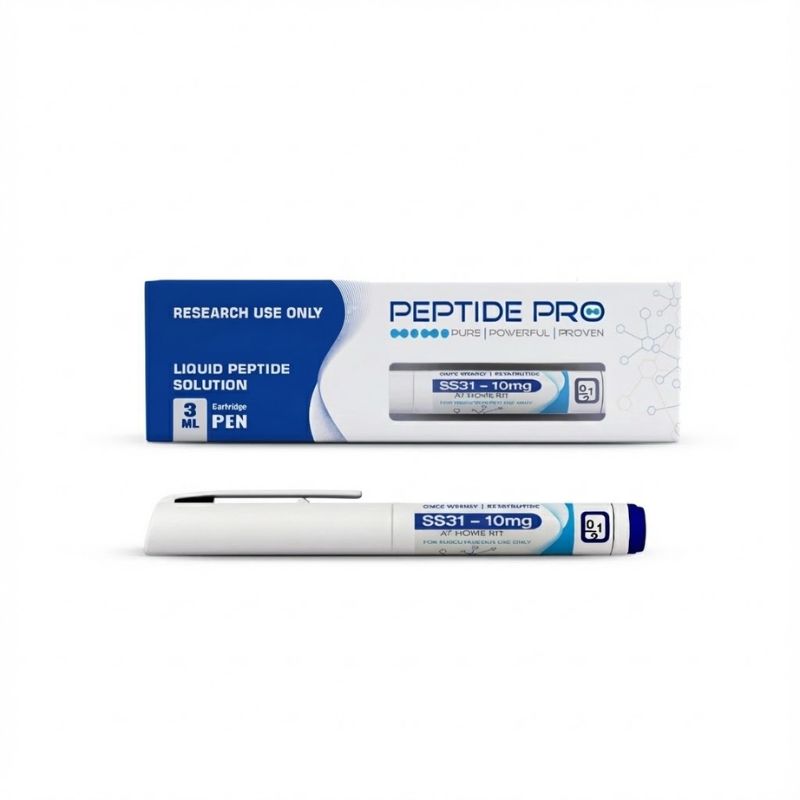
| Specification | Detail |
| Category | Mitochondrial Bioenergetics & Cell Biology |
| Product Name | SS-31 (Elamipretide / Bendavia) |
| Quantity | 10mg (Total Active API Concentration) |
| Formulation | Sterile Lyophilised Solution in Bacteriostatic Water |
| Delivery Method | 3ml Precision Reconstituted Pen |
| CAS Number | 736992-21-5 |
| Molecular Formula | $C_{32}H_{49}N_{9}O_{5}$ |
| Molecular Weight | $\approx 639.8 \text{ g/mol}$ |
| Purity | >99% (HPLC Analysis) |
£109.00
Abstract The SS-31 (Elamipretide) 10mg peptide pen represents the precise, low-volume standard for mitochondrial research, specifically designed for in vitro assays, cell culture supplementation, and localised tissue perfusion studies. This cell-permeable tetrapeptide targets the inner mitochondrial membrane (IMM) with exquisite specificity, binding to cardiolipin to stabilise respiratory supercomplexes. Unlike higher-concentration variants intended for systemic administration in animal models, the 10mg formulation is optimised for protocols requiring micro-molar precision, such as determining the IC50 for ROS inhibition in isolated cardiomyocytes or exploring bioenergetic resuscitation in ophthalmic explants. It serves as the fundamental tool for establishing baseline mitochondrial efficiency metrics.
Primary Biological Pathway: Electron Transport Chain Optimisation
The core utility of the 10mg SS-31 pen is the investigation of electron tunnelling efficiency.
By interacting with cardiolipin, SS-31 reduces the electrostatic repulsion between cytochrome c and the IMM. This facilitates a more efficient electron transfer, minimising the stalling of the chain that typically results in superoxide generation. Research at this dosage level is often conducted on permeabilised fibres or isolated mitochondria to measure State 3 (ADP-stimulated) respiration rates, verifying that the peptide enhances ATP synthesis without altering the proton motive force (uncoupling).
Secondary Research Finding: Ophthalmic and Neural Bioenergetics
SS-31 is a leading candidate in research regarding high-energy demand tissues such as the retina and the optic nerve. In models of Dry Age-Related Macular Degeneration (AMD) or glaucoma, mitochondrial dysfunction in the retinal pigment epithelium (RPE) is a primary pathology. The 10mg concentration allows researchers to perform intravitreal or topical simulations in explant models, investigating whether cardiolipin stabilisation can prevent RPE atrophy and preserve visual signal transduction pathways under oxidative stress.
Tertiary Research Finding: Senescence and Autophagy
Mitochondrial health is a gatekeeper for cellular senescence. Dysfunctional mitochondria release damage-associated molecular patterns (DAMPs) that trigger inflammation (inflammaging). Researchers utilise the 10mg format to treat fibroblast or stem cell cultures, observing whether SS-31 supplementation delays the onset of the senescence-associated secretory phenotype (SASP). Furthermore, studies are examining the link between cardiolipin structure and mitophagy (mitochondrial recycling), hypothesising that SS-31 promotes the healthy clearance of defective organelles.
Long-term Genomic and Safety Observations
At the 10mg scale, genomic research often focuses on the nuclear-mitochondrial coordination. Studies are quantifying the expression of nuclear respiratory factors (NRF-1, NRF-2) to understand if the bioenergetic improvements induced by SS-31 exert a feedback control on nuclear transcription. This data is critical for understanding the “retrograde signalling” pathways involved in cellular adaptation to metabolic stress.
Purity: Validated at >98+% via High-Performance Liquid Chromatography (HPLC). The presence of the synthetic amino acid 2,6-dimethyltyrosine (Dmt) is verified, which is crucial for the peptide’s ability to scavenge radicals within the lipid bilayer.
Appearance: The 3ml pen contains a clear, colourless, sterile liquid.
Precision: The pen delivery system allows for administration in micro-litres, ensuring that researchers can prepare culture media with exact nanomolar concentrations.
Storage: The product must be stored at $2^{\circ}C$ to $8^{\circ}C$.
Refrigeration and Shelf Life
The SS-31 10mg Pen requires strict cold-chain maintenance ($2^{\circ}C$ to $8^{\circ}C$). The shelf life is 12 months in the sealed state. Once opened, the bacteriostatic environment preserves the solution for 28 days. For cell culture applications, we recommend aliquoting the pen output into sterile cryovials if not using the full volume immediately, although keeping it in the original pen device at $4^{\circ}C$ is the preferred method to maintain sterility.
Shipping Stability
We utilise medical-grade thermal packaging. The peptide is stable for up to 72 hours at ambient UK temperatures. However, given the precision required for in vitro bioenergetics, we strongly recommend “Next Day” delivery to ensure the reagent arrives with its cardiolipin-binding affinity fully intact.
Freezing Warning
Do not freeze. Freezing can cause cryo-precipitation of the peptide. In cell culture studies, adding a previously frozen and potentially aggregated peptide can lead to physical sedimentation on the cell monolayer, causing mechanical stress and invalidating toxicity data.
The SS-31 10mg Pen is the specialized choice for In Vitro and Ex Vivo Research.
While animal studies require large systemic doses (see our 50mg pen), cellular studies require minute, precise quantities. Using a high-concentration pen for a petri dish experiment leads to massive waste and dilution errors.
The 10mg pen bridges this gap, providing a concentration that is easily diluted to working strength (nM to $\mu$M range) for cell media. It allows laboratories to conduct high-throughput screening of mitochondrial function without consuming their stock of systemic-grade reagents.
For researchers conducting scalability studies, we recommend the following product hierarchy:
Step 1 (Cellular/Explant): SS-31 10mg (Current Page).
Step 2 (Acute Animal Model): SS-31 25mg.
Step 3 (Chronic Animal Model): SS-31 50mg.
This product is strictly for Research Use Only (RUO). It is not intended for human consumption, injection, therapeutic use (e.g., for Leber’s Hereditary Optic Neuropathy), or diagnostic procedures. The information provided is for educational and scientific reference only. Purchase is restricted to verified research institutions and qualified individuals. Any evidence of intended misuse for human application will result in immediate order cancellation and blacklisting, in compliance with UK research chemical regulations.
Explore our high-purity compounds — including Retatide (Retatrutide 30 mg), Semaglutide, and more.
Fast UK shipping. Lab-tested quality. Strictly for research use only.